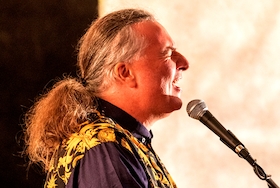
Niklas Paschburg - Support: Laura Masotto
A piano over a hundred years old, a remote house surrounded by the lush green of Brittany, no internet connection, and a tape recorder. L'Écho de Bretagne, the new EP by Niklas Paschburg, set to be released in the autumn of 2025 by Nettwerk Music Group, is a solo piano album – as essential as it is intense.
A work of silence, space, and slowness. Music that does not strive for effect but for truth.
While his previous work, Mexican Alps (2025), was the first time that the German composer and producer recorded an ambient electronic album without his preferred instrument – the piano – L'Écho de Bretagne is a direct response to this absence.
"The very renunciation of the piano awakened in me the desire to create a new work that highlights this instrument, which is so important to me, and blots everything else out," Niklas explains.
Born in 1994, Paschburg has shaped a musical path over the years that is deeply connected to travel, nature, and introspection.
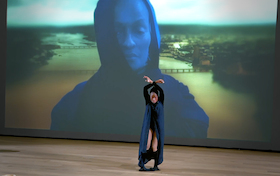
From his debut Tuur Mang Welten (2016) through Oceanic (2018), Svalbard (2020), Panta Rhei (2023), to Mexican Alps – as well as through soundtracks, remixes, and collaborations with artists like RY X, Hania Rani, Ásgeir, and Bryan Senti – his sound connects neoclassical, electronic, ambient, and pop-oriented composition.
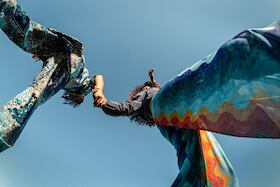
With L'Écho de Bretagne, the Hamburg-born and Berlin-based musician continues his exploration by seeking solitude in nature, just as he did with Svalbard – this time, however, even more radically: he completely detached himself from the internet, turned off computers and smartphones to fully immerse himself in his new music.
"I rented an old country house in Paimpol in Brittany because I knew there was a piano there," he recounts. "When I arrived, it turned out that the piano was not only over a hundred years old but also of an unknown brand, never restored, and quite difficult to play. But that was precisely what gave it a unique character, and I didn't give up. Sure, you couldn't play anything too fast on it. But how fascinating was that? I am convinced that limitations in composing can be an extraordinary source of inspiration – far more than total freedom."
Niklas also describes the decision to temporarily disconnect from the "always connected" life as both a creative and human experiment.
"I had my laptop and phone with me – only for emergencies – but they remained turned off. This decision led me to record L'Écho de Bretagne entirely analog – also in terms of the technology." A kind of mental cleansing.
"I believe I have never been as calm as during those days in Paimpol. Although I was working on a very concrete project and had little time, this time was more relaxing than any vacation."
However, it didn't go completely smoothly. "I had a small tape recorder with me that was easy to transport. But after I recorded a session, I found that the sound was distorted, full of crackling. I panicked because I was far away from any city where I could find a technician. Fortunately, it turned out that the fault lay with the old tapes I had brought. I only had to go online for a brief moment – to order new tapes. But that was just a moment. After that, everything was turned off again."
While he was waiting for the new tapes, he learned by chance from a local UPS delivery man that the package had been taken to a neighboring village.
"Because my phone was off, I couldn't track the package. So I asked this delivery person, who initially knew nothing. But from then on, we saw each other almost daily and talked... That's what being offline also means: reconnecting with the people around you, even with strangers. Through him, I eventually found out where the tapes had ended up – and he even helped me retrieve them by writing me directions on a piece of paper."
But there is another aspect that makes this EP special:
L'Écho de Bretagne was recorded completely live – all pieces are improvised, with all their imperfections.
This approach leads to a sound that is pure, organic, and authentic – consciously left so that the listener feels they are witnessing a live performance in their own living room.
The touch of fingers on the keys, the breathing of the wood, the tension of the vibrating strings – everything becomes part of the music.
No construction, just expression.
"Even now, when I listen to it, I feel that moment when I allowed myself to withdraw from everything: from reality, from words, from noise."
The result is a collection of floating melodies and atmospheres that reflect a state of soul – a refuge from the rush of time, a pause from the world.
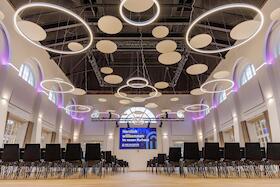
If you also feel that such a pause would be good – and who doesn't these days – come by when Niklas Paschburg is a guest at the beautiful Halle424 on December 3.
Doors: 19:00